Lakeview Apartments!!

Bella Vista 1-bedroom holiday rentals
Heart of Stresa Apartments!!

Stresa Apartments 1-bedroom holiday rentals
STRESA WEATHER

Click for Forecast
2019 DATES COMING SOON

CLICK HERE!
STRESA MAP

Malpensa / Stresa Bus
.jpg)
Available From 1 April to 13 Oct 2019 - Click to Book -
.jpg)
Showing posts with label wine. Show all posts
Showing posts with label wine. Show all posts
Monday, April 7, 2014
La Casera Cheese Shop
 4:27 AM |
  Dana Kaplan,
Stresa Sights
Dana Kaplan,
Stresa Sights

La Casera is located in Piazza Ranzoni, Verbania, under the arch in the blue wall.
La Casera is located in Verbania, right in the main piazza, and it can be reached quite easily with the VCO public bus or with the ferries.
Here's the door. You would never know what waits beyond, so go inside.

Looking in the door this is what you see. Where's lunch, you're wondering. But don't worry, you're in the right place. Walk through the shop, taking in sights and smells, whetting your appetite as you go.
Here's the door. You would never know what waits beyond, so go inside.
Looking in the door this is what you see. Where's lunch, you're wondering. But don't worry, you're in the right place. Walk through the shop, taking in sights and smells, whetting your appetite as you go.

( Continued ... )

Saturday, March 1, 2014
Wine: Travaglini Gattinara
.JPG)
Last evening we drank this wine: Travaglini Gattinara DOCG. The wine, made from 100% Nebbiolo grapes, is grown and bottled by the Travaglini family on their property in Gattinara, in Piemonte, only about 40 minutes from Stresa by car. The winery was established by Clemente Travaglini in the 1920s and has been passed down generation to generation. It's an excellent wine, but what I want to tell you about is the bottle, which is unique among wine bottles.
( Continued ... )
 Labels:
wine
Labels:
wine
Monday, September 10, 2012
What Am I Drinking Today?

My classic, simple Prosecco, in one of my favorite aperitivo seats in town. Buscion, at the corner of via Principessa Margherita and via Cavour. If you are lucky you can get a seat outside. Order your favorite aperitivo, or let Massimo suggest a wine for you. Sit with your back against the glass window of Buscion. Enjoy a plate of little stuzzichini, little appetizers. Watch the people walk by. Follow these simple rules for a very successful aperitivo. And then repeat another day.
More aperitivi I have had: Aperitivo Spots
Get to know Massimo: Three Questions With Massimo
Labels:
wine
Saturday, July 21, 2012
What Am I Drinking Today?

Today I enjoyed this beautiful Shakerato, served in a martini glass, at the Sky Bar atop Hotel La Palma. I met a friend here for a very special morning coffee, as she had not yet had the pleasure of seeing this spot, and this view. No need to tell you how much I enjoy this place. Or Shakeratos. What a great way to get my morning caffeine.
Labels:
wine
Friday, July 6, 2012
What Am I Drinking Today?

What I'm drinking today is a different version of the classic Spritz. This is a Campari Spritz, made with 3 cl. Campari, 7cl. of Prosecco, a splash of soda, and a slice of orange. I'm drinking it at Estremadura, an adorable little bar in Suna, Verbania, directly facing the lake.
Still thirsty? Here are some other aperitivo spots.
Labels:
wine
Monday, May 7, 2012
Sky Bar At Hotel La Palma

A spritz and a view at the Sky Bar.
Let's take a closer look at one of the aperitivo spots mentioned in this post, the Sky Bar on the rooftop at Hotel La Palma. I had heard a rumor at the end of last summer that La Palma had done a large reconstruction and opened a rooftop bar the likes of which had never before been seen in Stresa. One morning, after a run along the lake, I found myself in front of the hotel, and on a whim and still in jogging cloths, I stopped it to inquire. Despite my unannounced and somewhat sweaty visit, the owner of the hotel, a beautiful and elegant woman, offered to take me upstairs and show me the bar. We traveled up the elevator to the top floor, and when the doors opened, all I can say is, "WOW." It pretty much took my breath away. I'm not in Stresa anymore, I thought ... I'm in South Beach, Miami. My next surprise was to learn that Miami rooftop terraces had indeed been the inspiration for this one; the owner's son had traveled there and loved the concept.
Labels:
wine
Wednesday, September 7, 2011
Aperitivo Spots
Aperitivo... perhaps one of my favorite words in Italian. And one of my favorite things to do. On a Friday afternoon after a long work week... Meeting friends before going to dinner... Watching a sunset... As a transition between a long day of sightseeing and a relaxing evening... There are so many good reasons to stop and make this pause in your day. And there are so many wonderful spots in which to have an aperitivo. Here are some spots I've recently enjoyed aperitivi in:

If you're in neighboring Baveno, try a Spritz at the Lido Baveno. Lido is a popular beach club all day long, and becomes louder and club-like late in the evenings on the weekends, but in between is just perfect for me.
Via Piave, 66 28831 Baveno (VB)
0323 922856
(con't)
Labels:
wine
Saturday, April 9, 2011
Wine: A Do-It-Mostly-Yourself Wine Tasting At La Cambusa

Soooo many delicious Italian wines! How will you ever choose which to try? Here's one way to make this daunting task a little easier and a whole lot more enjoyable. Stop in at the wonderful Enoteca La Cambusa shop on via Cavour in Stresa and have your own wine tasting! Remember, we first went there last year and met Rosaria? Well, you should stop in and meet her too when you're here.
Rosaria tells me it was so popular last year that she will continue this year to let customers come in and enjoy bottles of wine right there in the shop. Here are the particulars again:
Labels:
wine
Thursday, January 20, 2011
Wine: The Wines of Pio Cesare

Pio Cesare vines in Alba.
Yesterday we read the first half of the wine column Annechino on Vino, written by my friend Joe, in which he lets us join him on his day trip to Alba, in the heart of Piemonte's wine country. Today let's continue with the second half, in which Joe tells us about some of the wines produced by the Pio Cesare vineyard.
Part 2... The Wines of Pio Cesare
One of the oldest operations in the area was started in 1881 by a fellow named Cesare Pio. But the walls within which he worked are even older. They were built back in the 1st century -- B.C.! Today, another Cesare, the fifth generation of the family, manages more modern facilities. Among them are new fermentation, racking, and aging areas -- one of which lies some 40 feet under the ancient building that dates from the era of the Roman Empire.
Although the Pio Cesare company owns over 130 acres of vineyards, it also closely supervises the work of associate growers from whom it continues to purchase crops, as it has for a number of generations. Each area has superior characteristics and is widely recognized by its own name. For example:
Barbera d'Alba, made from 100% Barbera grapes grown in the Barolo area and aged for 18 months. Its blackberry and plum aromas are quite prominent.
Gavi (or Cortese di Gavi). The vineyards are in the Gavi area; the wine is 100% Cortese grapes. It's a particularly pleasing pick.
Dolcetto d'Alba, a fresh, fragrant, and spicy wine made from 100% Dolcetto grapes. It's a great mate with pasta pomodoro, tomato, one of my favorites.
Moscato d'Asti, world famous for its fruity flavor, this is a familiar favorite due to its frizzante, bubbly, finish.
Pio Cesare Barolo, an Italian classic, made entirely from Nebbiolo grapes. It's one of those wines which, like us, gets even better with age.
Other prominent Pio Cesare products include those from the famous family-owned Ornato and Il Bricco estates, touted as "top vineyards in the whole Barolo area." Among the most notable are their Barbaresco and "Piodilei" Chardonnay, a wonderful white wine made from grapes of their very first Chardonnay vines.
Pio Cesare also produces wines made from Freisa, Arnese, and Grignolino grapes. These last three are not readily available in all parts of the U.S. That's unfortunate, because my experience with the Grignolino del Monferrato Casalese was uniformly memorable due to its peppery aroma and raspberry flavor.
With so many Barbaresco and Barolo wines available with top-tier ratings, those of Pio Cesare offer solid value, without top-tier pricing. Try them and see if you agree.
Fearing we'd find no fulfilling alternative to simply hanging close to the airport, wasting a whole day, we began to doubt the wisdom of getting there before the last minute. But after Alba we were convinced that, as usual, it's better to be early. On future trips, we'll again be allotting an extra day.
Read Part 1 of The Wines of Pio Cesare here.
 Labels:
wine
Labels:
wine
Wednesday, January 12, 2011
Wine: The Wines of Pio Cesare

Joe, who is in my Italian class, writes a very entertaining column on wine. The column is called Annechino on Vino. I love Joe's columns... He always makes me feel like I'm right there, traveling through Italy with him. This column is about an extra day he had in Piemonte, and how he spent it visiting the vineyard of the Pio Cesare company. I'll print the first half of Joe's column today, and the second part, about the Pio Cesare wines, tomorrow.
With Joe's permission, I give you Piedmont Picks:
While leaving Lombardy late last year, a couple of life's perennially prevailing questions came to mind, demanding reconsideration. What, we wondered, were the occasions for which it was better to be late than to be early? And, of more relevance for future planning, what category did the situation in which we found ourselves that day belong?
Except for determining which weekend we'll plan to visit our newly discovered relatives in Benevento, our trips to Italy require only two dates -- the day of arrival and the day of departure. And since most trips begin and end in Rome, we've long been familiar with the areas and addresses of our preferred accommodations.
This time however, we had planned to return home from Milan, whose airport I had been to on only one previous occasion. So in case we encountered any surprises along the way, an extra night's stay at a nearby hotel seemed like a prudent precaution to prepare for our morning flight out. But then the question arose of how to enjoy the extra day that we had as a result of getting to Malpensa so early.
By now you know that one of the principal pleasures we derive from Italy... is? Of course! So, realizing that we were within an hour's drive of one of the world's greatest areas for growing grapes, it was easy to agree upon the most desirable destination.
Italy's north-west is well worth wandering about for an entire vacation. But we had only a single day. So it was best to limit our visit to an area that most broadly mirrored the rest of the region ... and in Piemonte, it's the town of Alba.
Now, here's a little town with some mighty big attractions! There's the familiar Ferrero candies, the food emporium Eataly (now also in Manhattan) and perhaps the world's most priciest product, the precious white truffle. But its most notable agricultural attraction is produced by the nearly 300 wineries whose wines are among the very best in the world...
________________________________
Come back tomorrow to read Part 2, about the wines of Pio Cesare!
Come back tomorrow to read Part 2, about the wines of Pio Cesare!
Labels:
wine
Monday, August 2, 2010
August In Stresa -- The Spritz
The Spritz
.jpg)
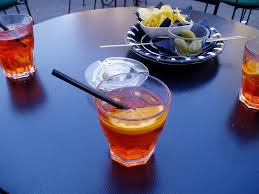
August... see more about it here.

Now this is one way to cool off during a hot summer day. We noticed these groups enjoying Spritz cocktails at Lido Beach Club in Baveno; however, it's the first time I've seen Spritz prepared in this way.
The Spritz cocktail was Austrian in origin before it became the quintessential drink in Venice. But in the past few summers it has also taken the rest of Italy by storm, and now can probably be called 'the' Italian summer cocktail. The classic recipe is:
The Spritz cocktail was Austrian in origin before it became the quintessential drink in Venice. But in the past few summers it has also taken the rest of Italy by storm, and now can probably be called 'the' Italian summer cocktail. The classic recipe is:
3 parts Prosecco
2 parts Aperol
a spritz of fizzy water
2 parts Aperol
a spritz of fizzy water
The drink should be served over ice and finished with a slice of orange.
August... see more about it here.
Sunday, April 18, 2010
Enoteca La Cambusa
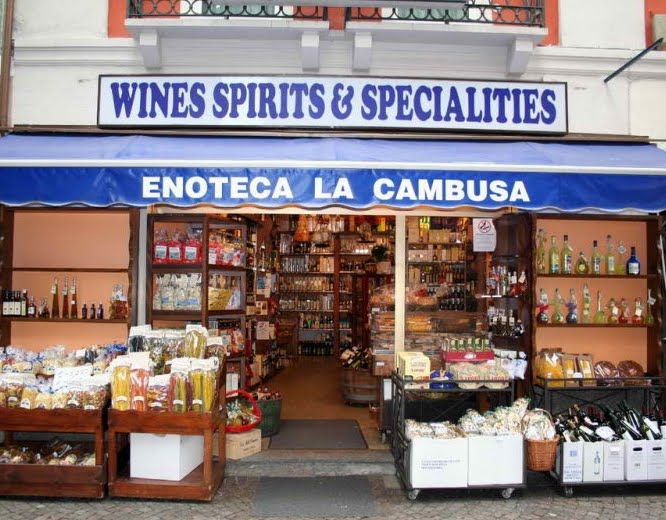 The very inviting entrance to La Cambusa, on via Cavour.
Late one afternoon I went to meet Rosaria, the proprietress of Enoteca La Cambusa on via Cavour, just a block back from the lakefront. When I entered the shop she was busy attending to customers. I heard her speaking perfect German with a couple looking at some sweets near the door. Then she moved to the barrels in the center of the shop where a young couple had some questions for her. They were French, and she responded to them in French, accent perfect as well. And when I introduced myself she switched effortlessly to English for me. Already impressed with the selection and look of her shop, I was immediately taken with Rosaria as well. She was getting ready to close up for the day, and so we had some quiet minutes to chat before she needed to leave.
 Rosaria, founder and owner of La Cambusa.
Rosaria Bolla and her family have owned and run Cambusa in this same location since 1981, and previous to that there was another location in town that had opened in 1961. The shop is divided into somewhat narrow sections, with shelves lining the walls from floor to ceiling. These hold a stunning selection of wines and spirits, but also local food specialties, pastas, and sweets. These alone would make Cambusa a favorite shopping destination of both locals and tourists alike, but what really makes it special here are the wine tastings that Rosaria offers.
 And the very inviting tables inside the shop.
Arrange a time with her for your group and Rosaria will choose a few wines for you. She'll explain them a bit, offer tastings of all to all with little appetizers as well. There are several square wooden high tables scattered around, with stools, for you to use for as long as you like enjoying the wines. The atmosphere in the shop is friendly and relaxed, one never feels pressured to buy, or to leave. If you're not there for a tasting you can still enjoy the tables and the ambience. Simply buy a bottle off the shelves and if you'd like to stay and enjoy it there Rosaria will open it for you and provide you with as many glasses as you need. And you'll probably get a bit of education and some great conversation also. (What a great idea for a rainy afternoon when you're wondering what to do!)
Rosaria proudly showed me a magazine article written about her in a Disney publication. It features a great photo of her in her shop, where everyone leaves as a friend of hers. She has built up quite a clientele over the years, with customers and fans from around the world, and when they return to Stresa they contact Rosaria first to ask her what they can bring back to her from their own countries.
I didn't stay for a bottle that day, as Rosaria was leaving. But you can be sure I'll be there the next time. Like everyone else who enters Cambusa, I feel I left with a new friend.
 Among the local specialties found on the shelves, Fil da Fer.
Cambusa also has a great selection of smaller items, the things that make perfect little gifts to bring home with you if you need to bring for many people without incurring too much cost or weight. They can also arrange shipping for wines and other products bought there.
via Cavour 27
28838 Stresa (VB)
Tel: 00 39 0323 31938
e-mail: contact@winelacambusa.com
Sunday, June 14, 2009
Three Beautiful Piemontese Wines

So much attention is given in our beautiful region to the wines of the Langhe - Barbaresco, Barolo, Nebbiolo and more - that it seems all the other Piemontese wineries fall into its shadow. Realistically, the wines of the Langhe are among the most expensive and some of the most balanced and structured wines in the world, and deserve the respect and attention (if not always the price tag) which they receive.
That's the opening paragraph of an article written by my good friend, Diana Strinati Baur. In this article, entitled Tre Belle Cose, Three Beautiful Things, she gives us an inside glimpse into three small and special wineries producing lesser known, but very much worth getting to know, Piemontese wines. Not only would these be worth searching out in a wine bar or enoteca, this is also a great idea for a day trip to these towns in the Piemonte countryside. Here's the article, with some of Diana's photographs, in full. It's good reading, about good drinking, and gorgeous places... Enjoy!
aziendaagricola.mutti@libero.it
Telephone: 0131 884119
Andrea's wife Adrina speaks English well.
Producer of Cortese, Savignon Blanc, Cabernet, Dolcetto, Barbera and Timmorasso


 The photovoltaic panels on the first building, we learned, are to power one of two presses. The first press is an old manual one, over a hundred years old. It is only powered by human muscle. The other, a modern press, is powered by the panels.
Tre Belle Cose - Three Distinctly Different Vineyards in Southwestern Piemonte
So much attention is given in our beautiful region to the wines of the Langhe - Barbaresco, Barolo, Nebbiolo and more - that it seems all the other Piemontese wineries fall into its shadow. Realistically, the wines of the Langhe are among the most expensive and some of the most balanced and structured wines in the world, and deserve the respect and attention (if not always the price tag) which they receive.
But to pursue the wines of the Langhe and pay no attention to the wines of the neighboring regions is to shortchange Piemontese wine in general. Italian wines from all regions have made tremendous strides in production quality over the last two decades. Organic growing techniques, more patience with the maturation process, and slower fermentation have raised the overall quality found at both small and large producers. Nowhere is this truer as in the regions of the Monferrato, the Roero and the Colline Tortonese, which have grown strong and stable in the shadow of the Langhe.
We have visited many wineries over our years in Piemonte. We go back to some; we forget quickly that others exist. Here I have outlined three classic Piemontese wineries. I have chosen them for the fact that they all differ, they are all owner operated by three very distinct characters, and they all produce the finest wines of their particular genre.
Andrea Mutti - Le Colline Tortonese
Location: San Ruffino 49 Sarezzanoaziendaagricola.mutti@libero.it
Telephone: 0131 884119
Andrea's wife Adrina speaks English well.
Producer of Cortese, Savignon Blanc, Cabernet, Dolcetto, Barbera and Timmorasso
A couple of years back, my friend, the award winning chef and cook book author Gina DePalma, and I were chatting it up on the phone about wine, when she told me, "Oh, by the way, we had a tasting at the restaurant the other night. There was a fabulous wine - from your area - a white." I assumed it had to be a Roero Arneis, the straw colored, richly textured white wine from the Roero, the region across the river from the Langhe.
She said, "Nope. This one is from around Tortona and hardly anybody makes it. It's called Timorasso." I could not believe that I had to hear about a Piemontese wine from a dyed-in-the-wool New Yorker, although she is an Italy expert. I ran up to Alessandria and found a bottle of Walter Massa Timorasso 2005 Derthona. Derthona, the enoteca owner told me, is the ancient spelling of Tortona. He also explained the small growing area for the Timorasso grape and that it had gone forgotten for many years, with no one even trying to make a vintage out of it until Massa had rekindled the interest in the old grape and planted a section of his 17 hectares.
I gulped at the price - €23 - and brought the bottle home.
Of course Gina was right. This is a complex white, with absolutely no need to ever see the inside of a barrel. Layers upon layers, the golden flavor of Gewürztraminer coupled with the grassy freshness of a Gavi. Fruity. Balanced acids. But still, it was hard to justify the price.
Fast forward two years. Our friends Peter and Marsha Clifford, who own a home in Umbria, have become regular visitors to the Monferrato. One of their local restaurant friends in Citta Civitella recommended a couple of wineries up our way, one being a Timorasso specialist in the Tortonese region. His name is Andrea Mutti, and we ended up going together to visit him.
The Colline Tortonese borders Lombardia to the north and to the west, and Monferrato to the east. Bucolic, pristine, and without a tourist in site, a person could literally be rendered speechless by the beauty of the area. It was out of Tortona that we drove in a southwesterly direction to the town of Sarezzano, a sleepy hilltop community with beautiful views all around. Andrea Mutti's thirty acres consist of vineyard, woodland and orchards where he and his wife grow "Pesca del Volpedo," a prestigious peach type, which is a specialty of the region.
After listening to Andrea's delightful summary of the history of the area, complete with stories about the Spanish Occupation, the local bandits and how Napoleon saved the day, we sampled his wines. His Timorasso was as good, if not better, than Massa's.
Andrea explained that growing the Timorasso grape is very easy - as long as it is grown in the correct terrior. The more complex a wine, the more structure it has, the more specific is the growing area. Timorasso differs from, say, a Muller Turgau in so far that it is a much more complex wine, and is highly dependent on the earth structure in the valley where it comes from. The simpler the wine, the less specific the growing area needs to be. This is a plus and a minus for Timorasso, as its quantities will always be limited to those produced by only a handful of producers in these hills. Mutti produces approximately 4,000 bottles a year.
Mutti Timorasso Derthona 2007 retails for between 10 and 14 euros.
Domenico Botto
Azienda Agricola St. Ubaldo
Regione Botti 26 15011 Moirano - Acqui Terme
Telephone 0144 311 546
Italian only Producer of: Dolcetto d'Acqui DOC, Dolcetto Superiore, Brachetto d'Acqui DOCG, Amista (Dolcetto/Brachetto blend), Brachetto Secco, Albarossa
Regione Botti 26 15011 Moirano - Acqui Terme
Telephone 0144 311 546
Italian only Producer of: Dolcetto d'Acqui DOC, Dolcetto Superiore, Brachetto d'Acqui DOCG, Amista (Dolcetto/Brachetto blend), Brachetto Secco, Albarossa
Here in Acqui Terme, we have two wines which define our specific area. One is Brachetto d'Acqui DOCG, which traditionally is a lightly sweet, highly floral dessert wine, rose in color. The other is Dolcetto d'Acqui DOC, on of the five designate growing areas for this (despite its name) moderately dry, fairly high tannin red wine, which has come into its own over the past five years.
Our very favorite producer of both is Domenico Botto, who lives and works on his hill above Acqui Terme. His nine acres form an amphitheater like bowl below his home and wine cellar, and anyone we have taken there is in awe of the panorama.
Arriving at St. Ubaldo is like arriving at a secret haven. The gate opens, and you are greeted by one of the friendliest, most genuine people you can imagine. If the weather is nice, you can walk in the vineyards and sometimes even taste the cherries and peaches and figs along the way.
At St. Ubaldo, you taste wines in Domenico's living room and you share your salami with his 11 year old mutt, Kika. It is a personal, wonderful experience. Afterwards, everyone heads downstairs into the wine cellar for a barrel tasting.
The Acqui Terme appellation for Dolcetto is known to be the lightest in the group. All of the other four (Asti, Alba, Doglani, Ovada) are known for bigger tannins, deeper cherry tones and higher alcohol content. But because Domenico exercises patience in the harvesting process (waiting to absolute full maturation), in the fermentation process (slow) and in the aging process (he waits a full year to put anything in the bottle, six months longer than the appellation requires), he produces one of the fullest Dolcetti in the Acqui appellation - with a 13 percent alcohol content, a robust, berried fruit flavor. He also makes a barrique aged Dolcetto Superiore (unusual for the already high-tannin Dolcetto but definitely rounds out the wine).
His Brachetto d'Acqui DOCG, lightly frizzante, full of peach and rose petals, has received the best in its class at VinItaly and has to be tried to be appreciated.
St. Ubaldo is a certified organic producer and employs no full time help. Domenico does it all himself.
Giovanni Scaglione
Forteto della Luja
World Wildlife Federation Oasis
Regione Candelette 4
14050 Loazzolo
Telephone: 0141 831596
English is spoken
Producer of Barbera, Monferrato Rosso, Brachetto Passito and Moscato Passito
World Wildlife Federation Oasis
Regione Candelette 4
14050 Loazzolo
Telephone: 0141 831596
English is spoken
Producer of Barbera, Monferrato Rosso, Brachetto Passito and Moscato Passito
I cannot complete a summary of three wineries without including one Barbera d'Asti producer. This wine, which gets relatively little international attention compared to its Barbera d'Alba counterpart, deserves far more, as far as we are concerned. I have chosen to highlight a winery I have written about before, a winery that is representative of all that is good about this region. It is also a winery whose bottles have made it into places like Joe Bastianich's Italian Wine Merchants in New York, which, for a small organic producer, is a very big thing indeed.
One arrives at the Forteto not quite knowing what to expect. Down the gravel road, one comes to the first building, which is a bit hidden and topped with photovoltaic solar panels. Around the curve, you arrive at the main house.
A few minutes later, you can see it - you have arrived on the fine line which divides the Monferrato from the Langhe. From the property, you can see Barbaresco's famous tower to the left, and to the right, in the distance, is the city of Alessandria and the start of the Padano Plains.
Giovanni showed us the views and the steep, mountainous vineyards from every perspective, and explained the ecosystem, the importance of the sea winds and the moisture for the grapes, the significance of having vineyards surrounded by woods for organic farmers (birds live in the woods, and birds eat the insects), and explained the microclimate up here in the mountains around Loazzolo.
Moscato Passito is a wine pressed from dried Moscato Grapes. The fermentation process takes up to two years. The result is an exquisite passito for which Loazzolo holds the DOC. By the way Loazzolo is the smallest village in Italy to have a DOC. And it is for this Moscato Passito. This is a very rich, smooth sweet wine, with an alcohol percentage of between 11.5 and 12.
Loazzolo is part of the Brachetto d'Acqui DOCG growing region. The DOCG, however, is only for the sparkling version of Brachetto, which has only been produced since World War II. Before that time, the area only produced Brachetto Passito, and this is the only Brachetto which the Forteto makes. It is pressed from dried Brachetto grapes in a similar process to the Moscato Passito. The result is a completely different sweet wine than the Moscato Passito, more amber in color and extremely fruity.
Forteto della Luja's version of Barbera (Mon Ross), a clean classic, is one of our favorites that we have found to date. It is a straight forward wine, and can be drunk with every course, from antipasto through to the end of the meal. It was this wine which first got our attention and brought us to the Forteto in the first place. The wine is aged in steel and passes briefly through oak casks before being bottled and sold in the fall of the following season.
Le Grive is the Forteto's blend of Barbera and Pino Noir. The two grapes are complimentary. The Barbera, relatively high in acid and low in tannin, receives the Pinot Noir's low acidity and high tannin content well. The rich color of the Barbera compensates for the Pinot Noir's less full color. The wine is aged for two years in oak and for six months in the bottle. The blend is wine which is best enjoyed with a hearty meat-based main course.
Stepping out of the Langhe region can only enhance and expand your ideas on Piemonte wine and you will not go wrong with any of these three producers.
Labels:
wine
Thursday, April 30, 2009
Morellino di Scansano at Buscion

Massimo called and said, "I have a new Morellino in... come and try it." And when Massimo tells you to come and try a wine, you do, because it is going to be good. So we went to Buscion. The day was rainy; it's been raining a lot this spring.
I'd never heard of Morellino before. Morellino di Scansano, from the southern coastal region of Tuscany. Tell me about it, I said to my friend, who's a bit of a wine guy. "Morellino is Chianti's little brother," he told me. "He's from the same region. Morellino is just a very local name for the Sangiovese grape from which the Chiantis and the Brunellos of the region are made. In the village of Scansano, in the area of Toscano called Maremmo, they call this grape Morellino." The wine was fresh and crisp, as Morellinos can be served young, as early as March after the harvest. Massimo brought over my vitello tonnato, a local favorite. Veal filets, sliced thin and served with a white sauce made of tuna, mayonnaise, and capers spread over the top.
"It's hard to grow up as Chianti's little brother," my wine guy friend continues, " in his shade... It's worthless to try to look like him, or to fight against his popularity. The only thing he can do, Morellino, is to have his own personality, and to stress his own qualities that make him unique. That way, even when his big brother Chianti is hanging around with his friends Brunello and Vino Nobile di Montepulciano, little Morellino di Scansano will still stand out." And he does... Morellino was awarded the coveted DOCG designation in 2007.
And this is why I love coming to Buscion. It's a small place, local and friendly. Sometimes it's crowded with tourists, like this day when they were inside escaping from the rain. But I never have to choose what to try. Massimo always has a suggestion. and I always learn a new thing or two about wine.
I'd never heard of Morellino before. Morellino di Scansano, from the southern coastal region of Tuscany. Tell me about it, I said to my friend, who's a bit of a wine guy. "Morellino is Chianti's little brother," he told me. "He's from the same region. Morellino is just a very local name for the Sangiovese grape from which the Chiantis and the Brunellos of the region are made. In the village of Scansano, in the area of Toscano called Maremmo, they call this grape Morellino." The wine was fresh and crisp, as Morellinos can be served young, as early as March after the harvest. Massimo brought over my vitello tonnato, a local favorite. Veal filets, sliced thin and served with a white sauce made of tuna, mayonnaise, and capers spread over the top.
"It's hard to grow up as Chianti's little brother," my wine guy friend continues, " in his shade... It's worthless to try to look like him, or to fight against his popularity. The only thing he can do, Morellino, is to have his own personality, and to stress his own qualities that make him unique. That way, even when his big brother Chianti is hanging around with his friends Brunello and Vino Nobile di Montepulciano, little Morellino di Scansano will still stand out." And he does... Morellino was awarded the coveted DOCG designation in 2007.
And this is why I love coming to Buscion. It's a small place, local and friendly. Sometimes it's crowded with tourists, like this day when they were inside escaping from the rain. But I never have to choose what to try. Massimo always has a suggestion. and I always learn a new thing or two about wine.
Go to Buscion and ask Massimo to recommend something to you. You'll be glad you did.
Al Buscion Vineria e Degustazione, Via Principessa Margherita, 18, Stresa
Labels:
wine
Wednesday, January 14, 2009
The Nebbiolo and the Fog

The fog. I hardly understand what thing is the fog, and I don't like it. It makes things grey, it limits my sight, but when I discovered how it feeds and protects the acids of the grapes from which comes my favorite wine I changed my mind.
Those poetic words were written by a Piemontese friend to explain the Nebbiolo grape to me. Nebbiolo, which grows in a relatively small region in Piemonte, is something you should get to know, if you don’t already, when here in northern Italy, as it is considered by many to be the most noble of all Italian grapes. Nebbia means fog, and each autumn, when the intense fog comes rolling in and hangs over the Langhe region where the Nebbiolo grows, it creates conditions that have been impossible to duplicate anywhere else on Earth, and wines considered among Italy
The fog has a reason. Nebbiolo, precisely. We Piemontese have grown up with the Nebbiolo. It is the wine of Sunday, of holidays, to open on special occasions, and on the Nebbiolo have we developed our fine taste for wine in general. Perhaps it is for this that it is so difficult for us to find a wine better than this. More than 30 different wines are made with the Nebbiolo grape, all of them particular in their own right, but the Barolo, Barbaresco, and the Gattinara represent the best, the excellence that can be achieved. Its brilliant ruby red color, that tends toward garnet with reflections of orange with the years, its perfume elegant and delicate, of rose and violet, its taste dry and velvety, with good body and medium tannens, of fruit and pink berries, especially raspberry, all of this over time assuming a hint of tobacco, all combine together like a romance in a glass.
Truly an elegant description of an elegant wine. As a rule Nebbiolo wines are dark red and have a high level of alcohol. They have a rich aftertaste. They take a long time to mature fully; when they do the wine takes on its characteristic brownish-red color at the rim. These wines go well with strong flavored meats and stews and with strong cheeses that may overpower the taste of other lighter wines. For all the different wines produced from the Nebbiolo it still only amounts to 3% of the wine production in Piemonte. The Barolo and Barbaresco, so called for the towns of the same name, are given the most respect; wines from outside the designated region go by Langhe Nebbiolo and Nebbiolo d’Alba, among others. For all these reasons, a bottle of Nebbiolo wine will tend to cost more than other Piemontese wines such as Barbera or Dolcetto. One pays for rarity. I'll let his words summarize it for us,
It's been attempted to cultivate the Nebbiolo in other places in the world, but it has always failed. In the way that God has fixed the stars in their certain points in the sky to guide millions of travelers, perhaps he has also put the Nebbiolo here, in Piemonte, with the fog and the perfect conditions, as a fixed starting point, the reference point, for other wine to look to.
Labels:
wine
Tuesday, December 30, 2008
Franciacorta - Italy's Answer To Champagne

Franciacorta… the third wine to be discussed in my little miniseries on the sparkling wines of northern Italy . To recap, we have the Moscato d’Asti from Piemonte, and Prosecco, from the Veneto Lombardia . Land-locked Lombardia , Italy ’s largest, most populous region, home to Milano and Lake Como , is not known as a major wine-producing area, but it does have Franciacorta, Italy ’s truest answer to Champagne
Here are the similarities between Franciacorta and Champagne .jpg) Like
Like Champagne
 Like
Like
But there are differences as well, between these wines and their French cousins. Only a small amount of Franciacorta is produced each year; only one sixth the amount of Prosecco and far less than Champagne. They work better with food than Champagne
Franciacorta costs more per bottle than Prosecco or Moscato d’Asti. Look for it by the glass at wine bars; an excellent way to try it.
Labels:
wine
Sunday, December 28, 2008
Prosecco - Italy's Quintessential Aperitivo

Pro-SEC-co… Pro-SECCO… Prosecco… I never know exactly how to pronounce it, how to quite do that double ‘c’ sound, but no matter, I love saying it anyway. I’d go as far as saying that Prosecco is one of the reasons I go to Italy U.S. Italy ’s three main sparkling wines, Moscato d’Asti, Prosecco, and Franciacorta, today I’ll focus on the Veneto ’s contribution, Italy
It’s possible that Prosecco’s signature fizziness was discovered accidentally. Since the Veneto lies in the far northeast corner of Italy , against the Adriatic Sea, and with the Dolomite Mountains .jpg)

Today the best Proseccos are thought to be those from the area called Conegliano-Valdobbiadene in the Veneto
Coincidentally, the New York Times ran an interesting article today on the current state of the Italian Prosecco industry. Since Prosecco is the name of the grape, and not the region, it may be used for sparkling wines made from it, no matter where they are grown or the wine produced. There’s concern among the Italian growers of Prosecco in the Veneto
Like Italy Venice
Labels:
wine
Saturday, December 27, 2008
Moscato d'Asti and Asti Spumante - Piemonte's Sparkling Wines
 Just because New Year’s Eve and champagne are practically synonymous doesn’t mean you have to open something French to make a bubbly toast.
Moscato d’Asti and Asti Spumante are produced, naturally, around Asti .jpg) made today. The ripe Moscato Bianco grapes are separated from their stems just before being pressed. Then, the unfiltered grape juice is separated from the skins. The juice is fermented using the Charmat method, in the tank rather than in the bottle, but only for a short period of time. After fermentation the wine is filtered several times, finally leaving a clean and clear wine. Naturally high in sugar and low in alcohol, slightly fizzante, fizzy, Moscato d’Asti has become a sweet and fruity year-round favorite; perfect for apertivi or lunch, as well as paired with desserts. Simple and perfect.
made today. The ripe Moscato Bianco grapes are separated from their stems just before being pressed. Then, the unfiltered grape juice is separated from the skins. The juice is fermented using the Charmat method, in the tank rather than in the bottle, but only for a short period of time. After fermentation the wine is filtered several times, finally leaving a clean and clear wine. Naturally high in sugar and low in alcohol, slightly fizzante, fizzy, Moscato d’Asti has become a sweet and fruity year-round favorite; perfect for apertivi or lunch, as well as paired with desserts. Simple and perfect.
 made today. The ripe Moscato Bianco grapes are separated from their stems just before being pressed. Then, the unfiltered grape juice is separated from the skins. The juice is fermented using the Charmat method, in the tank rather than in the bottle, but only for a short period of time. After fermentation the wine is filtered several times, finally leaving a clean and clear wine. Naturally high in sugar and low in alcohol, slightly fizzante, fizzy, Moscato d’Asti has become a sweet and fruity year-round favorite; perfect for apertivi or lunch, as well as paired with desserts. Simple and perfect.
Its cousin, Asti Spumante, is more effervescent than the Moscato D’Asti. Spumante, literally foaming, is also produced from 100% Moscato Bianco, and produced similarly to the Moscato d’Asti, with the unfiltered grape juice being stored in tanks at near freezing temperatures to prevent fermentation until a desired time. Then, temperatures raised and yeast added to the tanks in the Charmat method, fermentation begins. The main difference between the two wines is the length of fermentation time. Shorter for Moscato d’Asti, and longer for the Asti Asti
It’s tradition here in Piemonte to have a holiday toast with one’s neighbors and family with one of these sparkling Moscato wines and panettone. Nice tradition… let’s keep it going.
Asti is an easy day trip from Stresa and many of the wineries are open for tastings.
Labels:
wine
Wednesday, December 10, 2008
Osteria del Castello
 The first time I went to Osteria del Castello was on a beautiful summer night, and we sat outside on one of the picnic-style tables arranged in front of the restaurant. There was a simple pergola of twigs and branches overhead, spun with twinkling lights and greenery, and the location of the osteria, in a quiet and dimly lit stone-paved piazza, lent even more to the ambiance. I never even put a foot inside the actual restaurant that evening. The menu was handwritten on a blackboard on the wall, and even that wasn’t necessary. The cameriere, the waiter, came to the table and told us what local cheeses, risotto, meat, and fish were being prepared. We ordered costata, steak, and it comes the way I love, a big, beautiful bistecca, perfectly cooked, brought to the table on a cutting board to slice and share as we liked. There were also giant knives, which made me think of medieval banquets and kings. I felt like jamming the point of the knife down into the wooden table after each cut. (I didn’t, but from the looks of the table many others had done so.)
 Piazza Castello, 9, Verbania
+39 0323 516579
Web site: www.osteriacastello.com
Monday, October 20, 2008
Aperitivo at Al Buscion
 Met a couple of friends yesterday for aperitivo at Al Buscion, in Stresa. Because it's only one block off the lake, and right next to a few of the biggest hotels in the old center of town, it's a popular spot for tourists. Listen to the conversations around you and you'll hear English, German, French, and Italian. Last night the large table in the corner was filled with Germans who were happily celebrating something. One after another, they hushed their group and made toasts that then collapsed the group into laughter. I love the international and happy atmosphere here. But I also love the wine. Buscion is an old Piemontese dialect word meaning the cork in the wine bottle, and wine is really the star here. Massimo enjoys trying new bottles and you never know what's going to be open. I asked for a red wine and I was served a Sangiovese from Montepulciano, very sweet and with a strong cherry aroma and flavor. My next glass of red was also Tuscan, but quite different. I like that Massimo uses beautiful glasses of the right shape for each wine. Every glass of wine here is worth toasting to!
Al Buscion Vineria e Degustazione, Via Principessa Margherita, 18, Stresa
Hours of operation vary depending on the season
Labels:
wine
Subscribe to:
Posts (Atom)
PLANNING A TRIP TO STRESA?

A Top Attractions Starting Point
VACATIONS AND WORKSHOPS

Before or after Stresa, plan more of your trip to Italy with Villa Vita!
CURRENCY CONVERTER

Click here for a fast and easy currency converter.
STRESA SIGHTS by DANA KAPLAN
