Lakeview Apartments!!

Bella Vista 1-bedroom holiday rentals
Heart of Stresa Apartments!!

Stresa Apartments 1-bedroom holiday rentals
STRESA WEATHER

Click for Forecast
2019 DATES COMING SOON

CLICK HERE!
STRESA MAP

Malpensa / Stresa Bus
.jpg)
Available From 1 April to 13 Oct 2019 - Click to Book -
.jpg)
Showing posts with label places to go and day trips. Show all posts
Showing posts with label places to go and day trips. Show all posts
Saturday, June 17, 2017
"Il Carlone" Statue Of San Carlo Borromeo
 1:12 AM |
  Dana Kaplan,
Stresa Sights
Dana Kaplan,
Stresa Sights

Have you visited "il Carlone" (Big Carlo) yet? It's fascinating. Interesting facts about this hollow bronze statue: It was built to commemorate San Carlo Borromeo, who was born in 1538 in the Borromeo fortress that at that time stood where now the ruins of la Rocca are. His parents, Lord Giberto II and Lady Margherita Medici of Marignano, ruled over much of the lake. Choosing a religious life, San Carlo was appointed Archbishop of Milan on 12 May 1564, and, some years after his death in 1584, Pope Paul V canonized Carlo on 1 November 1610. This statue built in his honor was completed in 1698, a collaboration between the designer Giovan Battista Crespi, better known as “Il Cerano” and the sculptors Siro Zanella and Bernardo Falconi.

It is truly a masterpiece of engineering. Until the building of the Statue of Liberty this was the tallest hollow bronze statue in the world, and is still number 2. In fact, Frédéric Auguste Bartholdi, who designed the Statue of Liberty, came to Arona to study the statue’s structure. A plaque can be found at the foot of the Statue of Liberty commemorating the inspiration given by the ‘Sancarlone’, now no longer the largest statue in the world.
The statue is 90 feet (35 meters) tall. You can climb to the top, with a fascinating view of the internal structure, and, at the top, gaze through various windows. The climb consists of a spiral staircase, and then a long ladder to the top.


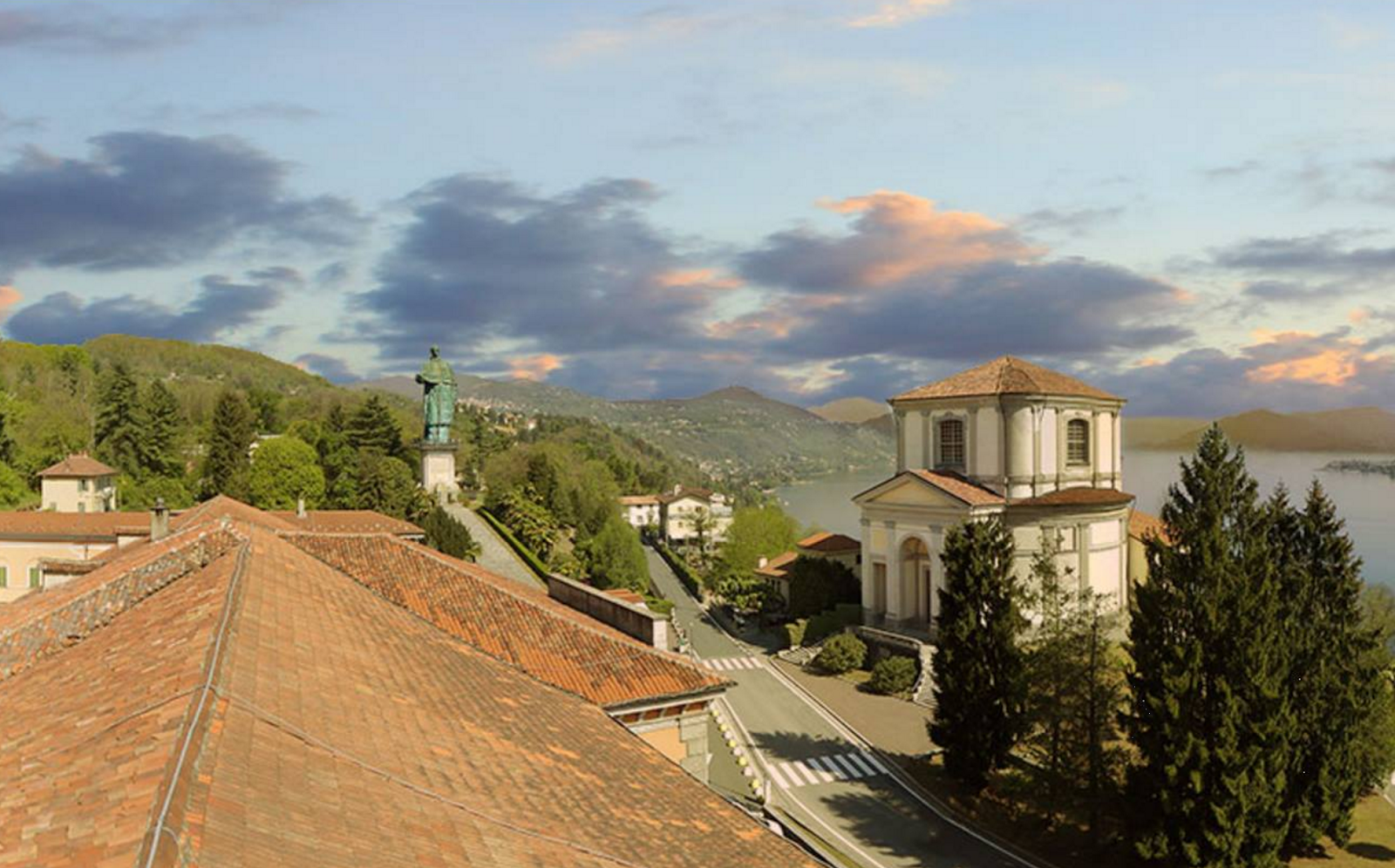
Ready for it? Intrigued? Get all the information on the website. San Carlo is just outside Arona, easily reachable by car.You can also visit the gardens, the church, and the small Sacre Monte. Directions, ticket information, and much more can be found here: www.statuasancarlo.it
all photos courtesy of the main website
 Labels:
places to go and day trips
Labels:
places to go and day trips

Thursday, June 1, 2017
Meditation Path, Isola San Giulio, Orta

Shhhh.... We're walking on the silent path that encircles the Basilica di San Giulio, on Isola San Giulio, in Lago d'Orta. Walk the short circle in one direction, and then turn around and walk it in the other. Why? To read the signs which are hung every few meters along the path. In one direction you are taking the "Way of Silence," and the messages on the signs are reminders to be silent, to be aware of the wind, the water, the sound of your steps, and to learn in the silence. Read it as a poem as you go. In the other direction, you are on the "Way of Meditation," which offers thoughtful phrases, such as, "Every journey begins near to you." Read the thought, and meditate on it as you continue to the next sign.
I won't print out all the words here; I want you to discover them on your own.
And take time to notice other beautiful details along the way... It's a short walk, with a lot of beauty in a small space.


Make this part of a day trip to Orta, our neighboring lake with so much charm of its own.
Labels:
places to go and day trips
Saturday, May 20, 2017
The Painted Village Of Legro, Near Orta

When you're driving to Orta, before parking the car in the large parking lots near the historic city center, or once you leave, take a very quick detour and go to see the interesting little village of Legro, just a couple of minutes outside of the town of Orta.
Since 1998 Legro has been a part of a rather special group of 127 Italian towns, the L'Associazione Italiana Paesi Dipinti, the Association of Italian Towns. Many walls of the tiny village are painted with colorful frescoes. The subjects of the murals painted on the walls of the village were mostly inspired by the work of the local poet and writer Gianni Rodari, and by films made in the Lake Orta area. I've posted a few photos I took on a recent drive through the town; I'll leave you to discover the rest on your own!


Legro is a frazione of Orta (a small town, part of the larger town), and is where the Orta-Miasino train station is. The map with the arrow shows the location. There's some parking around the station, and a fun birreria as well, if you want to walk around. If you only have a few minutes, a drive slowly around the narrow, pretty streets of the village will take you past many of the paintings.
 Labels:
places to go and day trips
Labels:
places to go and day trips
Friday, April 21, 2017
The Laveno "Bucket" Lift


Wow! Look at these views! These photos are from the website of the Funivia del Lago Maggiore, as it's called in Italian, but we all call it the Laveno "Bucket Lift." We call it this because the journey up the mountain is not in a gondola, or a chairlift, but truly in a large bucket that you stand in.

Having taken the ride, I can tell you that it is not as scary as it sounds. Here are some facts: The ride takes 16 minutes, and brings you to the top of Sasso del Ferro, an altitude of 1,100 meters. It's silent, and if you're truly nervous, there are also closed "buckets" you can choose to ride in. At the top, there is a restaurant and a bar, along with a park area, and a launching pad where you can watch the hang gliders, which I found fascinating.

The best way to get there from Stresa is to take the traghetto from Verbania Intra; the traghetto is the car ferry that crosses Lago Maggiore every 20 minutes. Just walk right on... Great views crossing the lake, and the ferry drops you in the town of Laveno Mombello, a charming town to walk around in before or after the trip up the mountain.
Here's the website, for all the information: www.funiviedellagomaggiore.it
Labels:
places to go and day trips
Thursday, June 11, 2015
Alpyland

That's Lago Maggiore way down below... You can see Isola Madre faintly on the right; Stresa is not visible below the hill. This is the view from Alpyland, the tobaggan attraction at the very summit of Mt. Mottarone. That box-like structure in center right is the top station of the funivia, the cableway, from Stresa. Take the 18-minute ride to arrive at that point, and then take the chairlift the rest of the way to the summit and Alpyland.
And then, one or two people at a time, ride the bobsled down! Don't worry... there are brakes and you can control the speed.
And then, one or two people at a time, ride the bobsled down! Don't worry... there are brakes and you can control the speed.

On the opposite side of the summit (Aplyland is on the back of this hill) you can enjoy this other slide or have an aperitivo at one of the few restaurants.

Or, after building up an appetite on the bobsled, take in a real mountain dinner of polenta, cheese fondue, and raclette at Casa della Neve to complete your top-of-the-mountain day.

And mostly, don't forget to look around at the 360 degree view of seven lakes, Swiss Alps, and on very clear days, il Duomo in Milan.
Aplyland's website: www.alpyland.com
Information on the cableway from Stresa: The Stresa-Mottarone Cablecar

Tuesday, March 19, 2013
Sierre, Switzerland -- Home Of The Best Raclette In The World

Che esperienza! What an experience! If you: 1)Love cheese, 2)Have access to a car, and 3)Want to spend a day in Switzerland, then take notes and put this onto your must-do list. Visit Chateau de Villa, a restaurant in Sierre, Switzerland, that bills itself as "Le Temple de la Raclette." I, who love Raclette, and who has already eaten some pretty darn good Raclette in various places in France, Italy, and Switzerland, have never had a Raclette experience like this one. Imagine a wine tasting... but with five types of cheeses instead of wine. And housed in the charming fifteenth-century building pictured above.
( continued ... )
Tuesday, May 17, 2011
Vogogna -- Cute Town, Great Restaurant, And A Castle!

The town of Vogogna, seen from the Castello di Visconteo.
Wednesday, July 28, 2010
Isola Madre

Each of the three Borromeo Islands has such a unique personality. If Isola dei Pescatori is a quaint home to simple fishermen, and Isola Bella boasts a palatial, magnificent abode for princes and princes, then Isola Madre falls in between the two. I would describe Madre as lush, verdant, and the most comfortable of the three islands. It is also the one on which you will see the least evidence of souvenir shops and other touristic trappings, and therefore the easiest in which to lose yourself.
The largest of the Borromeo Islands, Isola Madre is famous for its azalea, rhododendron, and camelia bushes, but also for the Cashmere Cyprus, the largest example in all of Europe and over 200 years old. Citrus plants were introduced to the island at the beginning of the 1500s by Lancillotto Borromeo, having been brought from Liguria. The microclimate of the island allows them to flourish, giving more of a tropical feel. The villa, built in the sixteenth century, was constructed atop ninth century ruins of a church and cemetary. After disembarking and purchasing a ticket (I paid 10 euro for mine at the island entrance, but many combination tickets are available) one enters the property through a gate, and begins a slow climb up gravel paths to the house. At first narrow and closed on one side by an ivy-covered wall, the path soon opens onto larger lawns and beds of plants. Many plants are labeled, as this island is renowned for its exotic botanical collection.
.jpg) The entrance gives hints of more to come.
The entrance gives hints of more to come.
.jpg)
.jpg)
.jpg)
.jpg) A few feathered friends.
A few feathered friends.
After leaving the house one can also visit the family chapel, and spend more time in the gardens. There are many paths off limits to tourists, and of course I wondered where they go as the wound around corners, but the bit of mystery is nice.
.jpg)
.jpg) A couple of lovely spots just outside the house.
A couple of lovely spots just outside the house.
.jpg) Where these stairs go is a mystery...
Where these stairs go is a mystery...
The largest of the Borromeo Islands, Isola Madre is famous for its azalea, rhododendron, and camelia bushes, but also for the Cashmere Cyprus, the largest example in all of Europe and over 200 years old. Citrus plants were introduced to the island at the beginning of the 1500s by Lancillotto Borromeo, having been brought from Liguria. The microclimate of the island allows them to flourish, giving more of a tropical feel. The villa, built in the sixteenth century, was constructed atop ninth century ruins of a church and cemetary. After disembarking and purchasing a ticket (I paid 10 euro for mine at the island entrance, but many combination tickets are available) one enters the property through a gate, and begins a slow climb up gravel paths to the house. At first narrow and closed on one side by an ivy-covered wall, the path soon opens onto larger lawns and beds of plants. Many plants are labeled, as this island is renowned for its exotic botanical collection.
 The entrance gives hints of more to come.
Following arrows along a designated route one is treated to views of the towns across the lake. You're also bound to encounter several brightly colored feathered friends along the way to the villa.


 A few feathered friends.
The villa itself is simple but elegant. It looks like a home that people could actually live in, and not only live in but enjoy living in. It looks like a well-loved home. Wax statues here and there, in rooms partitioned off from the public, are dressed in period clothing from the 16th and 17th centuries, making the effect even more realistic. The tour winds past two completely captivating seventeenth century puppet theaters much used by the family, one stage depicts hell, with a fire-breathing dragon prop off-stage to the right.
.jpg) An interior hallway, much as it looked 400 years ago.
An interior hallway, much as it looked 400 years ago.
 An interior hallway, much as it looked 400 years ago.
After leaving the house one can also visit the family chapel, and spend more time in the gardens. There are many paths off limits to tourists, and of course I wondered where they go as the wound around corners, but the bit of mystery is nice.
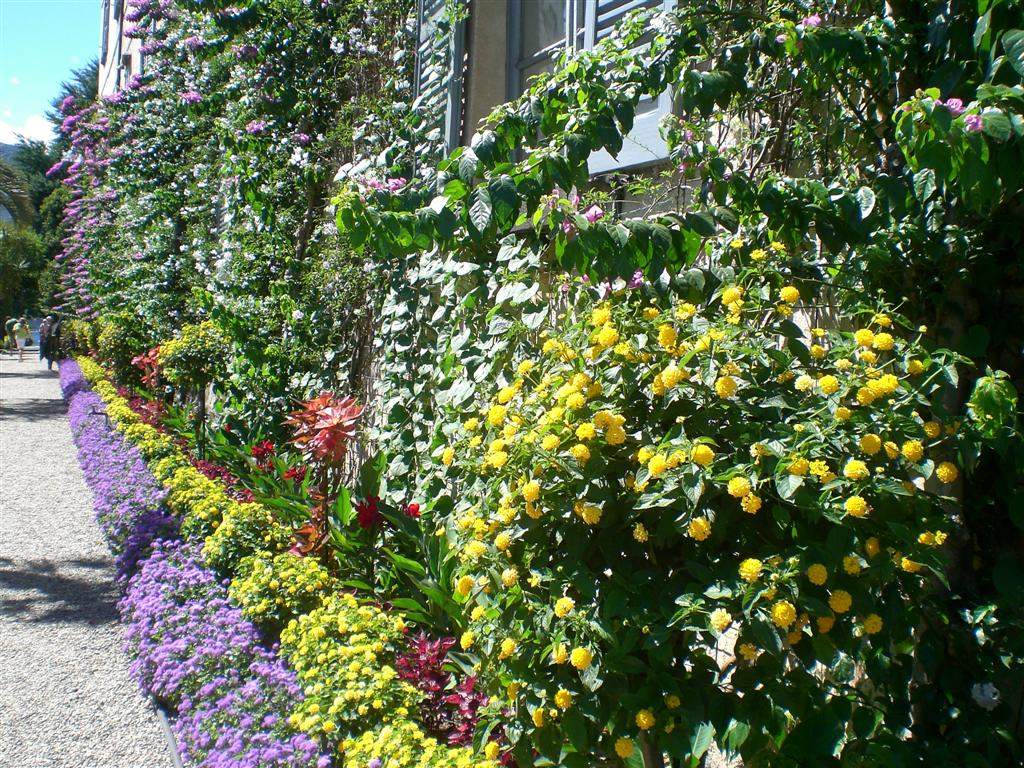
 A couple of lovely spots just outside the house.
 Where these stairs go is a mystery...
There are two snack bars and one full restaurant on the island, near the dock. There is also a small souvenir area. None of them are intrusive or interfere in any way with the serenity and lushness of the island. Wear comfortable shoes, and budget yourself a good hour and a half or longer, to benefit from the peaceful ambience, before catching your ferry.
Here is the link to the main Borromeo Tourist site:
http://www.borromeoturismo.it
And about the other islands:
Isola dei Pescatori
Isola Bella -- A Little Background
Here is the link to the main Borromeo Tourist site:
http://www.borromeoturismo.it
And about the other islands:
Isola dei Pescatori
Isola Bella -- A Little Background
Thursday, March 4, 2010
The Sacre Monte Near Stresa
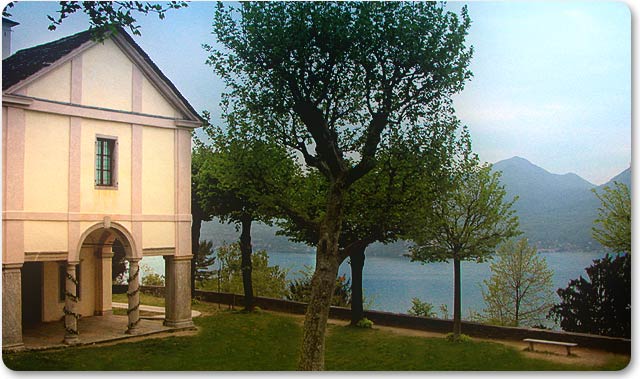
Sacro Monte, overlooking Lago Maggiore, Ghiffa
In this Easter season several local tour operators have organized day tours centered around the famous Sacri Monti in this area. Piemonte and Lombardy are rich in these 'sacred mountain' sites, which are valued by the religious for their sanctity, considered of great beauty by virtue of the skill with which they have been integrated into their surroundings, and because they house an incredible amount of important artistic material in the form of frescoes, wall paintings, and statuary. For all these reasons, in 2003 the nine Sacri Monti of Piemonte and Lombardy were inscribed jointly as UNESCO World Heritage Sites. Several are located close enough to Stresa to create a day dedicated to discovering them. Here's a quick guide to some of the sites closest to Stresa:
The Sacro Monte di Orta San Giulio is a Roman Catholic complex dedicated to St. Francis of Assisi. It is located on the hill called San Nicolao, overlooking the western shore of picturesque Lago Orta, about a 30-minute drive from Stresa. Construction began in 1583, with the original plan calling for 36 chapels; 20 were ultimately built. Construction ended in 1788. The chapels contain many artworks of very high caliber, having been commissioned by well-known painters and sculptors of the times. The architectural styles can be seen to change with the 200 years of building. The walk to the hill summit is steep, the path between the 20 chapels clearly marked, and the views, architecture, and art offer surprises at every turn.

Chapel no. 15, Sacro Monte d'Orta San Giulio
Sacro Monte della SS Trinita' di Ghiffa is located in the small community of Ghiffa, about 30 minutes from Stresa, overlooking Lago Maggiore. This complex, dedicated to the mystery of the Trinity, was influenced by an earlier small oratory located here on Mount Cariago. The view of Lago Maggiore is sweeping, and the architecture displays a high level of design. Just as impressive is the landscaping, which clearly required much planning and research. Sadly, the founders and builders are unknown. The Chapel of the Blessed Virgin Mary Crowned was the first constructed here, in 1647. The main themes represented here in the art work are the Counter Reformation, and later, the Passion of Christ.

The Sanctuary of the Trinity, at Ghiffa.

Three Angels Visiting Abraham, at Ghiffa.
Three Angels Visiting Abraham, at Ghiffa.
Sacro Monte Calvario di Domodossola. This Sacro Monte is located on the Mattarella Hill, overlooking the charming town of Domodossola, which is located about 20 minutes north of Stresa, in the foothills of the Alps. This complex was begun in 1657, in response to the wishes of the Capuchin friars Gioacchino da Cassano and Andrea da Rho. The chapels are dedicated to the Via Crucis, the Stations of the Cross, and are positioned along a devotional route which begins on the edge of Domodossola and ends at the summit. The chapel on the summit was completed in 1690 and in 1828 the philosopher Antonio Rosmini founded the Institute of Charity here.

View of Chapels 9 and 11, Domodossola.
Inside Chapel 11, Domodossola, Jesus Dies on the Cross, 1663.
Inside Chapel 11, Domodossola, Jesus Dies on the Cross, 1663.
Can you imagine a day planned hiking these areas? What a great combination of serenity, exercise, history, nature, and spirituality. A car is necessary to travel easily between sites, but no site is more than about 30 minutes from another. What a nice idea for a warm spring day, to rent a car, pack up some panini and cheeses, put on your walking shoes, and discover some of the Sacri Monti of Piemonte.
Itinerary idea for the Easter season: How about a day spent wandering the Sacri Monti, a day viewing the spectacular tulip gardens at Villa Taranto, a day trip to Milan to view da Vinci's Last Supper, and a day visiting the Borromean Islands, newly opened for the season? Add a special spring dinner as the perfect finishing touch.
all photos courtesy of Wikipedia.
Friday, August 14, 2009
Parco And Zoo Pallavicino
 Hai una carota per me? Do you have a carrot for me?
One morning, instead of my usual jog along the lake, I decided to combine my exercise with bit of sightseeing. And so instead of turning left at the Stresa Imbarcadero, I turned right, and jogged about five minutes the short distance to the Parco and Zoo Pallavicino. I was able to do a good invigorating walk on the hilly paths of the 20 hectares of the park and zoo, and then, after cooling down with a water bottle bought at the Chalet Bar, I walked through again, more leisurely this time.
The Parco and Zoo Pallavicino is an interesting combination of zoo, historic villa, and beautiful Italian garden. From my perspective, visiting in July when all is in full bloom, I'd say it seemed more garden than zoo. But little travelers may see it differently, and that the cages and enclosures are hidden behind plants until one is directly upon them might give children a bit of a surprise-around-every-corner feel. Actually, it did for me as well. To walk through a rose garden, and then around a water pond, only to come nose-to-nose with a zebra in his cage, was quite novel. Make sure you notice both the famous cypress arches, and the over 40 species of mammals and exotic birds.
 The rose garden.
 Famous cypress arches line the entrance road, framing Lago Maggiore. Beautiful, even on an overcast morning.
 A water garden.
The interior of the villa, built in the 1800s, is not open to visitors, but its grounds are used as a venue for some of the Stresa Festival events. It, and all the parkland, is still owned by the Pallavicino family. They made the park available to the public in the 1950s, and it's become one of the popular sights in Stresa, whether you're looking for gardens, things to do with children, or tutte le due, both.
 Villa Pallavicino, as seen from the top of the zoo. Summer concerts are held in the courtyard.
The park is usually open from mid-March until late October. Maps are provided at the ticket booth. If you don't want to walk from Stresa, the zoo offers the trenino shuttle back and forth from the Stresa Imbarcadero; this is definitely part of the experience for little ones, as well as a convenience for all. Information about the trenino is on their website. And take note, the paths in the park go up and down fairly steep hills, and are for the most part only covered with gravel. Wear your comfy shoes.
If you are walking from Stresa to the park you will pass Lov Beach, a small beach, bar, and mini golf location. Also a nice stop for little ones.
If you are walking from Stresa to the park you will pass Lov Beach, a small beach, bar, and mini golf location. Also a nice stop for little ones.
Parco and Zoo Pallavicino are on the list of the Top Ten Things to do in Stresa. Take a look at the whole list here.
Web site for prices and current information: http://www.parcopallavicino.it/
Tuesday, June 30, 2009
Madonna del Sangue -- The Sanctuary at Re
 Sanctuario di Re -- The Sanctuary in Re
Today I'm going to tell you a story I like, about a church I like, in a town I like, and the miracle that happened there. Re is one of the small Piemonte mountain towns that you can stop and see if you take the Lago Maggiore Express train ride through the Italian and Swiss Alps. In fact, Re is the most easterly town in the Valle Vigezzo, and the last town where you can stop in Italy, being as it is located only 7 kilometers from the Swiss border. The sanctuary in Re has risen, over the centuries, around and above an ancient image of the Madonna breast-feeding her infant. This painting was frescoed on the outside wall of the ancient original church by an unknown artist sometime the 13th century. At that time the present sanctuary did not exist of course. What there was on the site was a small church dedicated to San Maurizio. But since the miraculous event, which took place there in 1494, the painting has been called "Madonna del Sangue," Madonna of the Blood. This story is about her and the beautiful sanctuary that has grown around her.
It was on the evening of April 29 of that year that one young Giovanni Zucono was playing with others outside the church. The game they were playing was called piodella; it was a game similar to baseball in that a short stick of wood was used to hit an object; in this case, the object was a metal disc, such as a coin, and the goal was to hit it as close as possible to a target. The story goes that this particular time Giovanni lost, and as so often happens with boys, he also lost his temper, and he flung his coin in the face of the Madonna on the wall. From the moment of impact, at the point where it hit, an outpouring of blood came from the wall, and the outpouring did not stop or subside for the twenty days that followed.
 The fresco called Madonna del Sangue -- Madonna of the Blood
Immediately an altar was built in front of the image. Then, between 1606 and 1628 a church larger and more grand was built around the altar, incorporating the image inside. In 1894, on the 400th anniversary of the miracle, it was decided to build an even grander edifice. Work began in 1922 on the present byzantine-renaissance structure. In 1958 Pope Pius XII awarded the sanctuary with the designation of Basilica Minore.
The fresco is protected inside the sanctuary today. And in a tabernacle behind the altar an ampule of dried blood is preserved. Many scientific tests have been done on it, and the results well documented. And indeed, the residual marks on the fresco have been shown to be blood.
The sanctuary at Re is surprisingly large, and stunningly beautiful. Inside, it is unexpectedly modern, with contemporary stained-glass clerestory windows that reflect colored beams of light down onto the neutrally colored walls and the bright bolts of blue fabric which drape dramatically from the center of the dome, cascading down to the floor.
 The center of the Sanctuary. Note that the prismatic effect on the walls and floor is from the light shining through the windows, and therefore constantly changing.
 A closeup look at a trio of the long stained glass windows.
Each year, to commemorate the miracle of the Madonna del Sangue, a pilgrimage takes place, with the devout walking from Domodossola to the church. You can see it with much less effort, by disembarking the Lago Maggiore Express in Re, or driving up to the Valle Vigezzo, and stopping to visit for awhile.
It was on the evening of April 29 of that year that one young Giovanni Zucono was playing with others outside the church. The game they were playing was called piodella; it was a game similar to baseball in that a short stick of wood was used to hit an object; in this case, the object was a metal disc, such as a coin, and the goal was to hit it as close as possible to a target. The story goes that this particular time Giovanni lost, and as so often happens with boys, he also lost his temper, and he flung his coin in the face of the Madonna on the wall. From the moment of impact, at the point where it hit, an outpouring of blood came from the wall, and the outpouring did not stop or subside for the twenty days that followed.
 The fresco called Madonna del Sangue -- Madonna of the Blood
Immediately an altar was built in front of the image. Then, between 1606 and 1628 a church larger and more grand was built around the altar, incorporating the image inside. In 1894, on the 400th anniversary of the miracle, it was decided to build an even grander edifice. Work began in 1922 on the present byzantine-renaissance structure. In 1958 Pope Pius XII awarded the sanctuary with the designation of Basilica Minore.
The fresco is protected inside the sanctuary today. And in a tabernacle behind the altar an ampule of dried blood is preserved. Many scientific tests have been done on it, and the results well documented. And indeed, the residual marks on the fresco have been shown to be blood.
The sanctuary at Re is surprisingly large, and stunningly beautiful. Inside, it is unexpectedly modern, with contemporary stained-glass clerestory windows that reflect colored beams of light down onto the neutrally colored walls and the bright bolts of blue fabric which drape dramatically from the center of the dome, cascading down to the floor.
 The center of the Sanctuary. Note that the prismatic effect on the walls and floor is from the light shining through the windows, and therefore constantly changing.
 A closeup look at a trio of the long stained glass windows.
Each year, to commemorate the miracle of the Madonna del Sangue, a pilgrimage takes place, with the devout walking from Domodossola to the church. You can see it with much less effort, by disembarking the Lago Maggiore Express in Re, or driving up to the Valle Vigezzo, and stopping to visit for awhile.
Re is only one of the fascinating towns you can visit on the Lago Maggiore Express. Read more about that here, and if you have a free day to make this trip I wholeheartedly recommend it.
Top two photos: courtesy of Wikipedia.
Bottom two photos: stresasights
Bottom two photos: stresasights
Subscribe to:
Posts (Atom)
PLANNING A TRIP TO STRESA?

A Top Attractions Starting Point
VACATIONS AND WORKSHOPS

Before or after Stresa, plan more of your trip to Italy with Villa Vita!
CURRENCY CONVERTER

Click here for a fast and easy currency converter.
STRESA SIGHTS by DANA KAPLAN
