Lakeview Apartments!!

Bella Vista 1-bedroom holiday rentals
Heart of Stresa Apartments!!

Stresa Apartments 1-bedroom holiday rentals
STRESA WEATHER

Click for Forecast
2019 DATES COMING SOON

CLICK HERE!
STRESA MAP

Malpensa / Stresa Bus
.jpg)
Available From 1 April to 13 Oct 2019 - Click to Book -
.jpg)
Showing posts with label churches. Show all posts
Showing posts with label churches. Show all posts
Thursday, September 25, 2014
When Is Mass At The Church In Stresa?
 6:51 AM |
  Dana Kaplan,
Stresa Sights
Dana Kaplan,
Stresa Sights

A few readers have asked about mass times at the main church in Stresa, SS Ambrogio and Theodulo. This is the large church across from the boat station parking lot, across from the bus stop, where on one corner the Alibus pick-up stop also is located. In other words, it is the church used often as a landmark.
But for those of you who wish to use it for more than a landmark, take a look on the main doors when walking past. The mass times are posted on the door.
.JPG)
Translation:
Sundays and Holidays:
8:30
11:00
6:00 pm (18:00)
Weekdays: (Monday through Friday)
6:00 pm (18:00)
Saturdays:
6:00 pm (18:00)
Recitation of the Rosary:
5:30 pm (17:30)
Mass at the church in the village of Passera: Every Sunday at 9:30
Mass at the church at Collegio Rosmini (SS Crocefisso):
Weekdays at 6:30 (18:30)
The hours for confession are also posted on the door:
.JPG)
Translation:
Hours for the confessions:
The priest is present for confessions with the following availability:
Each weekday, 1/2 hour before mass, from 5:30 to 6:00 pm (17:30 to 18:00)
Saturdays from 5:00 to 5:45 pm (17:00 to 17:45)
Sundays from 10:00 to 11:00
( Continued ... )
 Labels:
churches
Labels:
churches

Monday, March 21, 2011
Milan: The Chiesa Santa Maria Presso di San Satiro

San Satiro tucked away on Via Torino near the Duomo.
I must tell you about this church in Milan. I'm fascinated by this! The Chiesa Santa Maria Presso di San Satiro, commonly known just as San Satiro, which is just south of the Duomo in Milan. Dating back to the 800s, the church was renovated in the second half of the 1400s by Bramante, and it has one very unusual feature. I read this about it:
San Satiro
by GB
Even for an architect such as Bramante, sometimes bureaucracy just gets in your way.
You’ve been commissioned by Milan’s Duke Sforza to rebuild the church of San Satiro. (Saint Satyrus was the brother and confessor of Saints Marcellina and Ambrose, the latter the patron Saint of Milan.) You’ve gotten the go-ahead from the religious authorities. It’s all systems go, funds in place….
… and then the town council construction board decides to ix-nay permission for the apse. The apse! Of all things, how absurd! How can you have a church without an apse!?
Monday, October 11, 2010
The Medieval Hamlet Of Carmine Superiore And Chiesa S. Gottardo
 Carmine Superiore.
Carmine Superiore is off the beaten trail, but ironically, it's only by being literally on the beaten trail that you can find it. To reach this tiny, almost uninhabited medieval hamlet one must find the right dirt path from the main road near Cannobio and Cannero Riviera on Lago Maggiore. Then, climb steeply for 100 meters to reach the rocky outcrop and the remains of the village. When you arrive, stand in front of the 14th century church and gaze out over the lake and the surrounding mountains. If there are no boats in view it is extremely easy to imagine that what you're seeing is much the same as what the first inhabitants of Carmine Superiore saw, one thousand years ago.
I walked up this path on a warm August morning with an Italian teacher and a group of American seminary students from her language school. The winding path up now has metal handrails on some of the steeper spots and sharp turns. After the last twist, the first view of the village is an imposing and misleadingly rustic side of the church. Narrow paths, sometimes of natural rock, lead maze-like around the homes; it feels safe and comfortable up there, and yet, at the same time, somehow precarious.
 Sign on the main road marking the beginning of the trail.
We were there for a special treat. One of the very few current inhabitants of the village had kindly agreed to meet us and unlock the large wooden doors of the church, San Gottardo.
Its origins go back to the years right at the end of the first millennium, at a time when the land around Lago Maggiore first became permanently populated. And in the 1500s, when the Mazzarditi brothers, who lived in the Castles of Cannero, were tormenting the area, little Carmine Superiore was a refuge and a sanctuary to those in need.

The students and I wandered around the church, which was begun in the early 1300s and consecrated by Cardinal Carlo Borromeo in 1574. It was named for the Saxon bishop of Gottardo, who traveled through these parts on his journeys to and from Rome. Only one thing tells us we are in the 21st century, the spotlights that have been embedded in the floor of the church to highlight some of the frescoes on the walls. Mostly partial frescoes now, the 15th and 16th century paintings depict bible stories. They had been covered with lime during a plague in the 17th century, in an effort to sterilize the building after it had been used as a hospital. They were only uncovered again in the past twenty years.


The small terrace area outside had been a cemetery, but now it holds a couple of long tables, and it is where we unwrapped our panini and opened a couple of bottles of Freisa d'Asi and had a small pranzo, lunch, before beginning our descent down the trail. There is no way to reach the village with a car. The church is used only on very special occasions. It was opened just five times last year for services. Again, spotlights apart, it is not difficult at all to imagine it is another time, another century. What a special opportunity to get a glimpse of a place much unchanged for hundreds of years.
Visit more churches: churches
Directions to find Carmine Superiore
By car: from the A26 motorway, exit towards Verbania and continue along the lakeside SS34 towards Switzerland. The hamlet of Carmine Inferiore is shortly before Cannobio. Leave your car in the car park and take the path to the church (15 min.).By train: the nearest railway station is Verbania-Pallanza, 29 km from Cannobio. You can reach Carmine Inferiore by the frequent bus service, from the station and then from Intra. The bus makes a stop directly at the base of the path.
aerial photo courtesy of illagomaggiore.com

Saturday, March 13, 2010
VIDEO -- The Sacri Monti
We have spoken about three of the local Sacri Monti, those at Orta San Giulia, Ghiffa, and at Domodossola. Now let's visit them again, in this beautiful video produced by the Distretto Turistico dai Laghi. Here, take a quick look at some of the details and exteriors of the sanctuaries, and a view of their grounds. Most impressive is an aerial view of the Sacre Monte Calvario di Domodossola, on its hilltop towering over the town of Domodossola below.
Thursday, March 4, 2010
The Sacre Monte Near Stresa
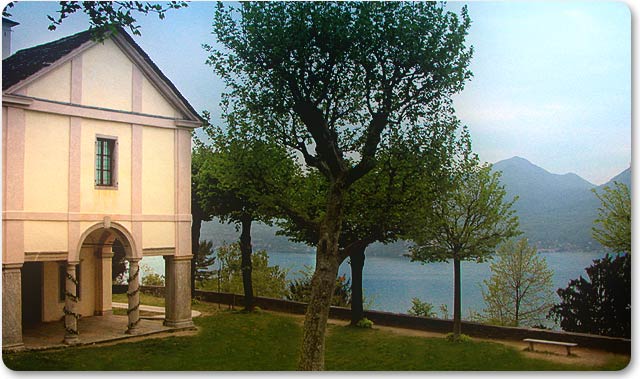
Sacro Monte, overlooking Lago Maggiore, Ghiffa
In this Easter season several local tour operators have organized day tours centered around the famous Sacri Monti in this area. Piemonte and Lombardy are rich in these 'sacred mountain' sites, which are valued by the religious for their sanctity, considered of great beauty by virtue of the skill with which they have been integrated into their surroundings, and because they house an incredible amount of important artistic material in the form of frescoes, wall paintings, and statuary. For all these reasons, in 2003 the nine Sacri Monti of Piemonte and Lombardy were inscribed jointly as UNESCO World Heritage Sites. Several are located close enough to Stresa to create a day dedicated to discovering them. Here's a quick guide to some of the sites closest to Stresa:
The Sacro Monte di Orta San Giulio is a Roman Catholic complex dedicated to St. Francis of Assisi. It is located on the hill called San Nicolao, overlooking the western shore of picturesque Lago Orta, about a 30-minute drive from Stresa. Construction began in 1583, with the original plan calling for 36 chapels; 20 were ultimately built. Construction ended in 1788. The chapels contain many artworks of very high caliber, having been commissioned by well-known painters and sculptors of the times. The architectural styles can be seen to change with the 200 years of building. The walk to the hill summit is steep, the path between the 20 chapels clearly marked, and the views, architecture, and art offer surprises at every turn.

Chapel no. 15, Sacro Monte d'Orta San Giulio
Sacro Monte della SS Trinita' di Ghiffa is located in the small community of Ghiffa, about 30 minutes from Stresa, overlooking Lago Maggiore. This complex, dedicated to the mystery of the Trinity, was influenced by an earlier small oratory located here on Mount Cariago. The view of Lago Maggiore is sweeping, and the architecture displays a high level of design. Just as impressive is the landscaping, which clearly required much planning and research. Sadly, the founders and builders are unknown. The Chapel of the Blessed Virgin Mary Crowned was the first constructed here, in 1647. The main themes represented here in the art work are the Counter Reformation, and later, the Passion of Christ.

The Sanctuary of the Trinity, at Ghiffa.

Three Angels Visiting Abraham, at Ghiffa.
Three Angels Visiting Abraham, at Ghiffa.
Sacro Monte Calvario di Domodossola. This Sacro Monte is located on the Mattarella Hill, overlooking the charming town of Domodossola, which is located about 20 minutes north of Stresa, in the foothills of the Alps. This complex was begun in 1657, in response to the wishes of the Capuchin friars Gioacchino da Cassano and Andrea da Rho. The chapels are dedicated to the Via Crucis, the Stations of the Cross, and are positioned along a devotional route which begins on the edge of Domodossola and ends at the summit. The chapel on the summit was completed in 1690 and in 1828 the philosopher Antonio Rosmini founded the Institute of Charity here.

View of Chapels 9 and 11, Domodossola.
Inside Chapel 11, Domodossola, Jesus Dies on the Cross, 1663.
Inside Chapel 11, Domodossola, Jesus Dies on the Cross, 1663.
Can you imagine a day planned hiking these areas? What a great combination of serenity, exercise, history, nature, and spirituality. A car is necessary to travel easily between sites, but no site is more than about 30 minutes from another. What a nice idea for a warm spring day, to rent a car, pack up some panini and cheeses, put on your walking shoes, and discover some of the Sacri Monti of Piemonte.
Itinerary idea for the Easter season: How about a day spent wandering the Sacri Monti, a day viewing the spectacular tulip gardens at Villa Taranto, a day trip to Milan to view da Vinci's Last Supper, and a day visiting the Borromean Islands, newly opened for the season? Add a special spring dinner as the perfect finishing touch.
all photos courtesy of Wikipedia.
Saturday, November 21, 2009
Chiesa Del Ss. Crocifisso At Il Collegio Rosmini
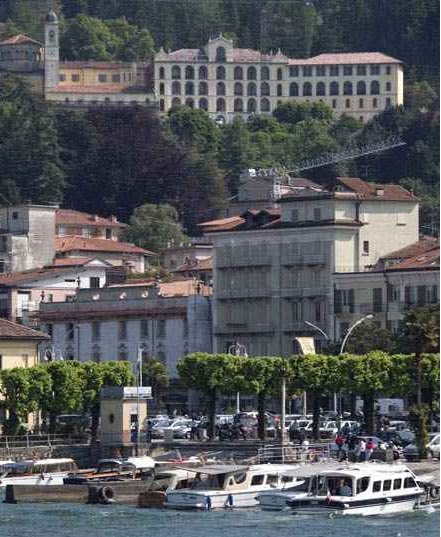 Il Collegio Rosmini, on the hill behind the city of Stresa, as seen from Lago Maggiore.
This week there was a special mass held in Stresa, at la Chiesa del Ss. Crocifisso at the Collegio Rosmini. The mass was in celebration of the second anniversary of the beatification of Antonio Rosmini, which took place on November 18, 2007, after it was authorized by Pope Benedetto XVI.
 This is the interior of the sanctuary at la Chiesa del Ss. Crocifisso at Il Collegi Rosmini.
 It's impossible to walk around Stresa without noticing the name Antonio Rosmini, and wondering who was this man who is featured so prominently here. There are streets and buildings named for him, a statue of him along the lungolago, and, of course, the imposing college that sits on a hilltop on the southern side of town. So, who was he? Born into a wealthy and respected family of Roverato in 1797, Rosmini decided at an early age to enter the priesthood, and he was ordained in 1821. He studied philosophy, and wrote much on the subject, but by the 1840s his beliefs and his writings had aroused great opposition in the church, and many of his works became forbidden readings. Rosmini, confident in his convictions, retired. He moved to Stresa, where he had already established a boarding school and center of education thanks to the very generous donations of Anna Maria Bolongaro, a wealthy and devout Stresiana who was a friend and follower. He would live in Stresa for the rest of his life. During his years in Stresa he taught his beliefs to his followers, who are called Rosminians. The Rosminians were both priests and nonclergy who believed in his ideas, and they followed his practice of educating youth, preaching, and performing works of universal charity. Before he died, in 1855, he did have the satisfaction of knowing that his questionable works had been declared free from censure.
What were his teachings that were so controversial? Rosmini devoted his studies to the old questions asked by many of the ancient philosophers, those of the origins, truths, and certainties of our ideas, and what, in essense, our human sense of 'being' is, where it derives from.
Clearly, the perception of Rosmini's works and his teachings have changed much in the 150 years since his death. So much so that, on June 26, 2006, Pope Benedetto XVI signed a decree recognizing Rosmini's heroic virtues, declaring him to be Venerable. Then followed the beatification in November 2007. Should any miracles be attributed to Rosmini, and should they be proven, he will become a saint. In the meantime, members of his parish are permitted to pray to him.
 Today, Il Collegio Rosmini in Stresa is a world-renowned religious, cultural, and educational center. Inside, Rosmini's remains are interred in a crypt in the Chiesa del Ss. Crocifisso. His bones are watched over by statues of the saints from the Lago Maggiore area. In a side chapel is a statue of Rosmini, kneeling with a book, sculpted by Vincenzo Vela of Ticino.
Do you like looking at different churches? Here's are a couple of other posts about some:
Chiesa di Santo Gervasio e Protasio -- Baveno's Parish Church
Chiesa di San Remigio
Or take a look at the entire category of chrches here.
Labels:
churches
Tuesday, June 30, 2009
Madonna del Sangue -- The Sanctuary at Re
 Sanctuario di Re -- The Sanctuary in Re
Today I'm going to tell you a story I like, about a church I like, in a town I like, and the miracle that happened there. Re is one of the small Piemonte mountain towns that you can stop and see if you take the Lago Maggiore Express train ride through the Italian and Swiss Alps. In fact, Re is the most easterly town in the Valle Vigezzo, and the last town where you can stop in Italy, being as it is located only 7 kilometers from the Swiss border. The sanctuary in Re has risen, over the centuries, around and above an ancient image of the Madonna breast-feeding her infant. This painting was frescoed on the outside wall of the ancient original church by an unknown artist sometime the 13th century. At that time the present sanctuary did not exist of course. What there was on the site was a small church dedicated to San Maurizio. But since the miraculous event, which took place there in 1494, the painting has been called "Madonna del Sangue," Madonna of the Blood. This story is about her and the beautiful sanctuary that has grown around her.
It was on the evening of April 29 of that year that one young Giovanni Zucono was playing with others outside the church. The game they were playing was called piodella; it was a game similar to baseball in that a short stick of wood was used to hit an object; in this case, the object was a metal disc, such as a coin, and the goal was to hit it as close as possible to a target. The story goes that this particular time Giovanni lost, and as so often happens with boys, he also lost his temper, and he flung his coin in the face of the Madonna on the wall. From the moment of impact, at the point where it hit, an outpouring of blood came from the wall, and the outpouring did not stop or subside for the twenty days that followed.
 The fresco called Madonna del Sangue -- Madonna of the Blood
Immediately an altar was built in front of the image. Then, between 1606 and 1628 a church larger and more grand was built around the altar, incorporating the image inside. In 1894, on the 400th anniversary of the miracle, it was decided to build an even grander edifice. Work began in 1922 on the present byzantine-renaissance structure. In 1958 Pope Pius XII awarded the sanctuary with the designation of Basilica Minore.
The fresco is protected inside the sanctuary today. And in a tabernacle behind the altar an ampule of dried blood is preserved. Many scientific tests have been done on it, and the results well documented. And indeed, the residual marks on the fresco have been shown to be blood.
The sanctuary at Re is surprisingly large, and stunningly beautiful. Inside, it is unexpectedly modern, with contemporary stained-glass clerestory windows that reflect colored beams of light down onto the neutrally colored walls and the bright bolts of blue fabric which drape dramatically from the center of the dome, cascading down to the floor.
 The center of the Sanctuary. Note that the prismatic effect on the walls and floor is from the light shining through the windows, and therefore constantly changing.
 A closeup look at a trio of the long stained glass windows.
Each year, to commemorate the miracle of the Madonna del Sangue, a pilgrimage takes place, with the devout walking from Domodossola to the church. You can see it with much less effort, by disembarking the Lago Maggiore Express in Re, or driving up to the Valle Vigezzo, and stopping to visit for awhile.
It was on the evening of April 29 of that year that one young Giovanni Zucono was playing with others outside the church. The game they were playing was called piodella; it was a game similar to baseball in that a short stick of wood was used to hit an object; in this case, the object was a metal disc, such as a coin, and the goal was to hit it as close as possible to a target. The story goes that this particular time Giovanni lost, and as so often happens with boys, he also lost his temper, and he flung his coin in the face of the Madonna on the wall. From the moment of impact, at the point where it hit, an outpouring of blood came from the wall, and the outpouring did not stop or subside for the twenty days that followed.
 The fresco called Madonna del Sangue -- Madonna of the Blood
Immediately an altar was built in front of the image. Then, between 1606 and 1628 a church larger and more grand was built around the altar, incorporating the image inside. In 1894, on the 400th anniversary of the miracle, it was decided to build an even grander edifice. Work began in 1922 on the present byzantine-renaissance structure. In 1958 Pope Pius XII awarded the sanctuary with the designation of Basilica Minore.
The fresco is protected inside the sanctuary today. And in a tabernacle behind the altar an ampule of dried blood is preserved. Many scientific tests have been done on it, and the results well documented. And indeed, the residual marks on the fresco have been shown to be blood.
The sanctuary at Re is surprisingly large, and stunningly beautiful. Inside, it is unexpectedly modern, with contemporary stained-glass clerestory windows that reflect colored beams of light down onto the neutrally colored walls and the bright bolts of blue fabric which drape dramatically from the center of the dome, cascading down to the floor.
 The center of the Sanctuary. Note that the prismatic effect on the walls and floor is from the light shining through the windows, and therefore constantly changing.
 A closeup look at a trio of the long stained glass windows.
Each year, to commemorate the miracle of the Madonna del Sangue, a pilgrimage takes place, with the devout walking from Domodossola to the church. You can see it with much less effort, by disembarking the Lago Maggiore Express in Re, or driving up to the Valle Vigezzo, and stopping to visit for awhile.
Re is only one of the fascinating towns you can visit on the Lago Maggiore Express. Read more about that here, and if you have a free day to make this trip I wholeheartedly recommend it.
Top two photos: courtesy of Wikipedia.
Bottom two photos: stresasights
Bottom two photos: stresasights
Wednesday, May 27, 2009
Chiesa di Santi Gervasio e Protasio -- Baveno's Parish Church

While waiting for the boat in Baveno I had enough time to wander up to Baveno's parish chiesa, its church, SS Gervasio and Protasio, which is only a couple of streets from the imbarcadero. Turn inland at via Monte Grappa and take a little walk up the long flight of stairs; it's well worth a look around. Although the buildings were built in different centuries, they blend together nicely.
 This is the view from the top of the staircase.
The oldest part is the Romanesque church and tower, which dates from the XII century. The church retains its original plain facade, go close and look, the facade contains some Roman tombstones which were uncovered when the building was constructed. Can you see the one to the left of the door? It reads, "Trophimus Daphidianus servo di Tiberio Claudio Cesare Augusto. Sacro alla Memoria Eterna"
 The baptistery, next door, octagonal in shape, is built on the foundation of a fifth century structure, but dates from the sixteenth century and boasts some beautiful renaissance frescos.
 Turning to my left I can enter this portico, which was added in the eighteenth century, creating an inner courtyard area. The baptistery and tower are behind me in this view.
 Between the arches delicately colored frescoes depict the stations of the cross.
 This photo, taken a different day, shows the tower and Baveno's waterfront as seen from the lake, with the mountain of Baveno pink granite in the background.
And just who were Gervasio and Protasio anyway? They were brothers, Christian martyrs, who lived and died in Milan in the second century. They are patron saints of Milan, as well as of haymakers. This fourteenth century french manuscript drawing depicts their martyrdom.

Manuscript drawing Wikipedia.
Labels:
churches
Sunday, April 19, 2009
Chiesa di San Remigio
I was a little bit late, and a little bit lost. I was walking through a section of Verbania that I didn't know, looking for a place I had never been before. In addition, it was all uphill, and the day was hot.
The road I was on came to a dead end at the top of the hill. There was a gate, a clearing, and this old church. I took one quick photo. I didn't try to enter. As I said, I was a little late, and actually a lot lost.

Now, I have stumbled onto information about that old church. And how I regret that I didn't stay longer, look around, go inside. I was at Chiesa di San Remigio, a Romanic-style oratory built in the 11th and 12th centuries. Yes. One thousand years ago. The front porch with its arched ceiling is new by comparison; it was added in the 16th century.
Had I ventured inside this is what I would have found. A church built entirely of square stones, all neatly arranged, with two naves of different lengths. It is assumed this is due to the position of the church on the rocky promitory where it sits. Inside I would have found cross vaulting, decorated semi-capitals, and frescoes dating from various ages, beginning with the early medieval era. In the lower apse there are images of Christ blessing a figure kneeling before him. This dates from the mid-eleventh century. And in the higher apse, a series of paintings from the thirteenth century depicts activities carried out in different seasons of the year.
Sigh...
If I had walked in there, not even knowing the age of the building or the paintings, but if I had walked in and discovered this, I would have considered it the luckiest of accidents. And I can't show you what's inside. You, like me, will have to wait until I have the opportunity to find San Remigio again. And I must remember, take the extra minute, take the chance, open the door...
The Chiesa di San Remigio sits just next to the grounds of the Villa San Remigio. This beautiful villa today houses the offices of the Province of Verbania, and the gardens are open by appointment only. The villa was built at the beginning of the twentieth century, by two lovers who created their dream garden here. But that is another story...
Chiesa di San Remigio and Villa San Remigio are on via San Remigio which is off of via M.Buonarroti in Verbania.
Labels:
churches
Subscribe to:
Posts (Atom)
PLANNING A TRIP TO STRESA?

A Top Attractions Starting Point
VACATIONS AND WORKSHOPS

Before or after Stresa, plan more of your trip to Italy with Villa Vita!
CURRENCY CONVERTER

Click here for a fast and easy currency converter.
STRESA SIGHTS by DANA KAPLAN
